12 The Additive Constants and the Third Law
Part V — The Third Law
Last updated: 16-07-2026
This chapter is not part of the exam.
12.1 Where this lecture is going
Seal \(\mathrm{N_2O_4}\) in a glass tube and warm it: the brown colour of \(\mathrm{NO_2}\) deepens, and in Lecture 11 the equilibrium constant was measured from that colour. Problem Problem 11.5 asked for the opposite: compute the constant from heat measurements alone, without ever watching the reaction. The computation stalled on the additive constants. Every energy the course has introduced carries an arbitrary zero and every entropy an arbitrary constant, flagged when the entropy was defined (Lecture 6: “the reference value \(S(O)\) will be fixed later in the course”) and sharpened to one pair per substance as open systems and reactions entered (Lecture 8, Lecture 11).
This last lecture examines the conventions themselves: what the general laws allow them to be, what they can never affect, where they block a prediction, and whether nature fixes any of them.
The argument needs only the first two laws. For a closed system the energy’s constant is fixed by the adiabatic work and can depend only on the conserved quantities; the entropy’s constant is fixed only along reversible processes, so one number is left open wherever no reversible process connects two states, as, in general, between the reactants and the products of a reaction. The Third Law supplies that number. Its consequences close the course: the heat capacities and the thermal expansion vanish at absolute zero, and absolute zero itself cannot be reached. A supplement carries the chemistry: the energy and entropy of a reaction, their measurement, and the absolute entropies that make the sealed tube’s equilibrium constant computable.
12.2 The Third Law
The energy is defined only up to an additive constant, and so is the entropy: the \(S_0\) that Lecture 7 left open, to be fixed by the last law. Before fixing anything, we settle what these constants can depend on. Work with a closed system, so that its conserved quantities \(q\) (the quantities no admitted transformation changes, among them whatever fixes the system’s size) are fixed. At a given \(q\) the equilibrium states are labelled by the temperature \(T\) and by the controls \(\lambda\), the variables besides the temperature that are set from outside.
For a homogeneous gas \(\lambda = V\) and \(q = n\). Consider a more complicated system: two gases that do not react, \(n_A\) moles of A and \(n_B\) of B, in a cylinder divided by a membrane permeable to A alone, so that B is held in the near chamber while A passes through and fills the whole (Figure 12.1). Two quantities are set independently: the total volume \(V\), through the outer piston, and the volume \(V_B\) left to B, through the membrane’s position. Each can be changed reversibly: the piston against the pressure of A, the membrane against the partial pressure of B alone, since A crosses it and presses equally on its two faces. Here \(q = (n_A, n_B)\) and \(\lambda = (V, V_B)\), two controls, and the entropy depends on both.
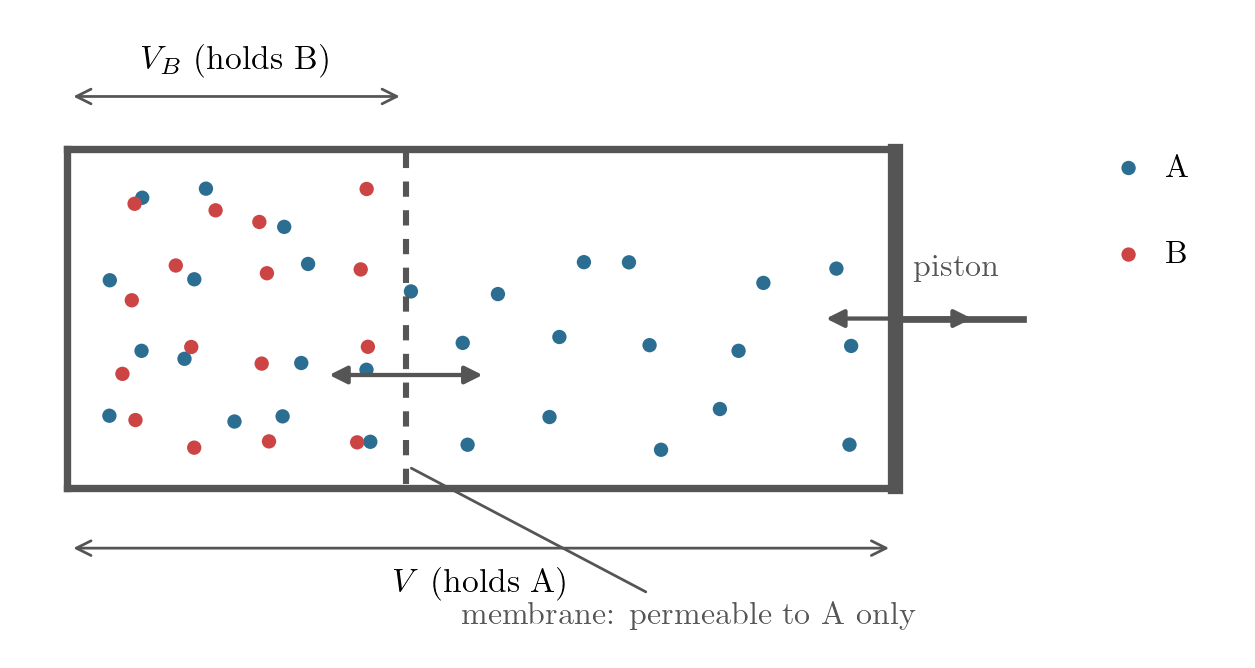
Recall how each function is built (Lecture 2, Lecture 6). The system is closed, so every state shares the same \(q\); take a reference equilibrium state \(O = (T_O, \lambda_O, q)\) and a general one \(A = (T, \lambda, q)\). If an adiabatic process joins \(O\) to \(A\), the energy of \(A\) is the adiabatic work, \[ U(T, \lambda; q) = U(T_O, \lambda_O; q) - W_{\rm ad}\big( (T_O, \lambda_O, q) \to (T, \lambda, q) \big) \] (Equation 2.9); if a reversible process joins them, the entropy of \(A\) is the integrated heat, \[ S(T, \lambda; q) = S(T_O, \lambda_O; q) + \int_{\substack{(T_O, \lambda_O, q)\,\to\,(T, \lambda, q)\\ \text{reversible}}} \frac{\delta Q}{T} . \] The reference values \(U(T_O, \lambda_O; q)\) and \(S(T_O, \lambda_O; q)\) are fixed by no measurement; they are the additive constants \(U_0\) and \(S_0\). A single reference does not settle the functions everywhere, since a process connects only some states: a state it cannot reach from \(O\) takes a constant of its own. The freedom is one constant per family of mutually reachable states, and the reaching processes differ, adiabatic for the energy and reversible for the entropy. We ask what labels the families.
For the energy each closed system is a single family. The adiabatic work fixes the difference between any two of its states, since an adiabatic process runs between them in one direction or the other: heat is never needed, one may warm by stirring, cool by expansion, and let the admitted reactions proceed, all within adiabatic walls. One constant thus covers the whole system; another system, of different \(q\) and reached by no process, carries an independent one. The energy constant is labelled by the conserved quantities alone, \[ U_0 = U_0(q) . \]
For the entropy the families are finer. The difference \(S(B) - S(A)\) is fixed only along a reversible process; between two states of one system that no reversible process joins, an irreversible one gives merely the Clausius bound \(S(B) - S(A) \ge \int_A^B \delta Q/T\), which does not fix it. The entropy therefore carries a free constant for each reversible class, and a single system may hold several: its states split into classes finer than \(q\).
The two constants differ in their reach: the energy constant is fixed across a whole \(q\), the entropy constant only within a reversible class. The two-gas cylinder is the first case, its two controls both reversibly operable, so its entropy is fixed throughout; a reaction is the second. Run to completion in an adiabatic vessel it carries reactants to products, fixing their energy difference, but no reversible process connects them, and their entropy difference is left open.
One number therefore stays undetermined: the entropy constant \(S_0\), free between the states of a given \(q\) that no reversible process connects. The last law removes it, and rests on two facts about the approach to absolute zero.
The first is Nernst’s. As the temperature falls to zero, the entropy ceases to depend on the controls, \[ \lim_{T\to0}\big[\, S(T, \lambda_1; q) - S(T, \lambda_2; q) \,\big] = 0 \] for any controls \(\lambda_1, \lambda_2\). Nernst read this from reactions among solids and liquids, where a reversible operation makes the difference observable, and took it to hold in general.
The second is that the entropy tends to a finite limit, and it does not follow from the first. Along a reversible path at fixed \(\lambda\) and \(q\), the calorimetric entropy of Lecture 7 is \[ S(T, \lambda; q) = S(T_1, \lambda; q) - \int_T^{T_1} \frac{C(T')}{T'}\,dT' , \] with \(C\) the heat capacity at fixed \(\lambda\) and \(q\). The limit as \(T\to0\) exists only if this integral converges at its lower end. Were \(C\) to approach a nonzero value \(C_0\), the integrand would grow as \(C_0/T'\) and the integral diverge, carrying \(S\) to \(-\infty\); the measured heat capacities instead fall to zero as a positive power of the temperature, fast enough for the integral to converge. That they vanish is an empirical fact, not a corollary of Nernst’s, and its explanation belongs to statistical mechanics.
P 12.1 For a closed system the entropy change between equilibrium states at one temperature vanishes as the temperature tends to zero, and the entropy tends to a finite limit. Its additive constant may then be chosen so that \[ \lim_{T\to0} S(T, \lambda; q) = 0 \] for every state (Planck’s convention).
At a fixed \(q\) the entropy’s limit exists, by finiteness, and is the same for every value of the controls, by Nernst (taken to hold in general); it is therefore a function of \(q\) alone. Choosing \(S_0\) to cancel it sets \(S \to 0\) for every state. The entropy’s constant is thereby fixed; the energy’s is not: no law does for \(U_0\) what Nernst does for \(S_0\), and it stays a convention attached to \(q\).
12.3 Consequences of the Third Law
The thermal behaviour was already met in stating the law: the finite limit holds only because the heat capacities vanish at absolute zero, \[ c_X \to 0 \quad (T \to 0), \tag{12.1}\] for a nonzero limit would make the calorimetric integral \(s(T, X) - s(0) = \int_0^T c_X(T')\,dT'/T'\) diverge (one mole, held at constant \(X\), the volume or the pressure). A temperature-independent heat capacity is thereby excluded at low temperature.
The ideal gas violates the law. The volume term of Equation 8.5, \(nR\ln\big(V/(n v_0)\big)\), makes the isothermal entropy change between two volumes the same at every temperature, so the \(T \to 0\) limit is not independent of the volume as Principle 12.1 demands; and its constant heat capacity, which sends the entropy to \(-\infty\), violates \(c_X \to 0\) as well. The ideal gas is a high-temperature idealisation; real gases condense first; what replaces the classical picture at low temperature is quantum-mechanical, and belongs to statistical mechanics.
Two consequences are mechanical. Define the expansion coefficient \(\alpha_V = V^{-1}(\partial V/\partial T)_{p}\), the counterpart of the compressibility \(\kappa_T\) of Lecture 8. At \(T = 0\) the entropy is independent of the pressure, so \((\partial S/\partial p)_T \to 0\); the Maxwell relation Equation 9.18 converts this into \[ \alpha_V \to 0 \quad (T \to 0): \tag{12.2}\] thermal expansion vanishes as the temperature falls to zero. By Equation 9.17, likewise, \((\partial p/\partial T)_V \to 0\); both derivations are among the problems.
Expansion coefficient \(\alpha_V = V^{-1}(\partial V/\partial T)_p\) — vanishes as \(T \to 0\) (Equation 12.2), as does \((\partial p/\partial T)_V\).
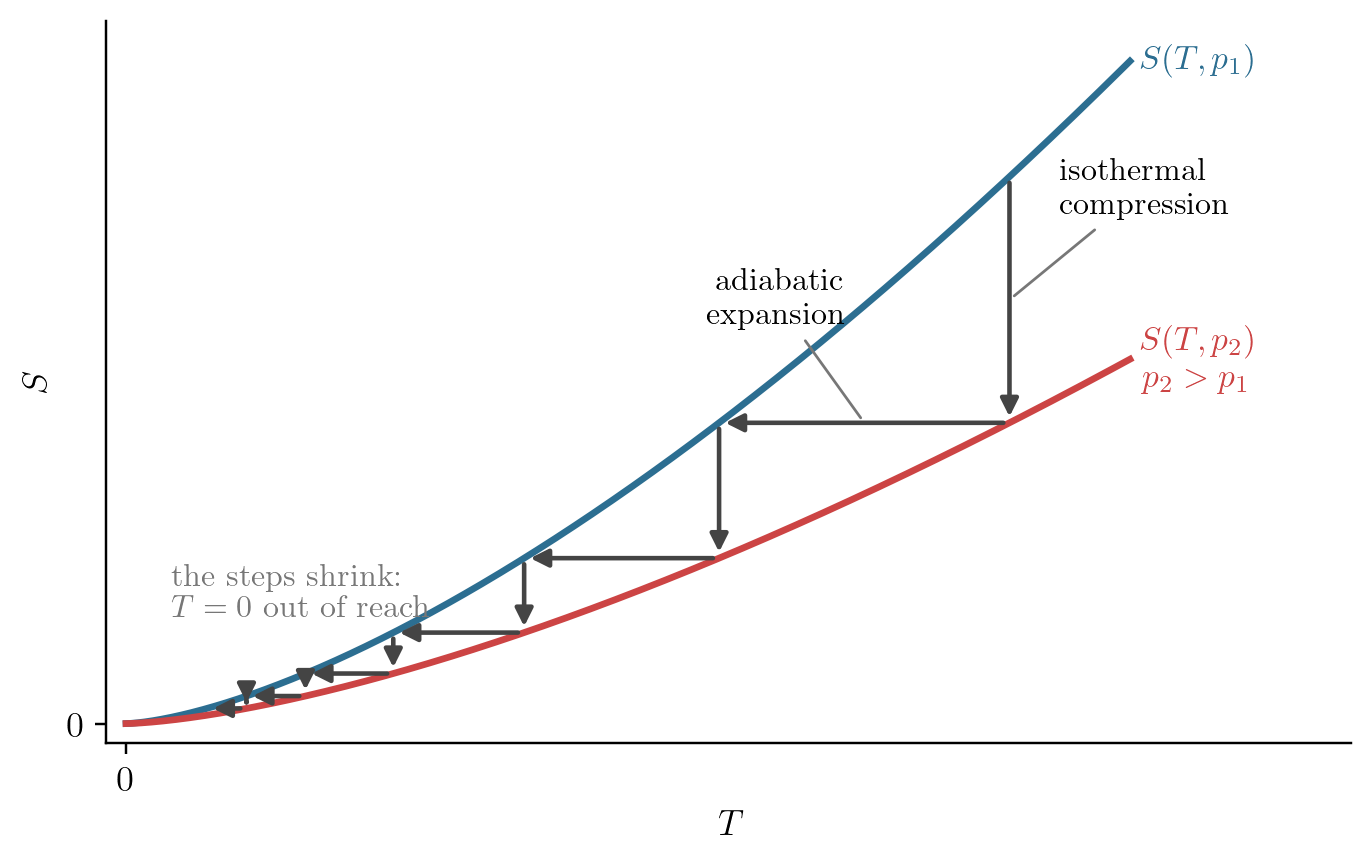
The last consequence is operational: absolute zero cannot be reached. With Planck’s convention every state at \(T = 0\) has \(S = 0\), and every state at \(T > 0\) has \(S > 0\), the calorimetric integral being positive; a process without heat exchange has \(\Delta S \ge 0\) (Equation 7.3); so no adiabatic process, reversible or not, ends at \(T = 0\) from \(T > 0\). Figure 12.2 shows what this does to the standard cooling scheme, a staircase of isothermal compressions and adiabatic expansions running between the curves \(S(T, p_1)\) and \(S(T, p_2)\): Principle 12.1 forces the two curves to a single point at \(T = 0\), and the steps shrink to nothing. This is one direction only: the Third Law implies unattainability. The converse fails, and the ideal gas is the counterexample: it violates Principle 12.1, yet its parallel entropy curves keep \(T = 0\) unattainable all the same (a problem).
Unattainability — no adiabatic process ends at \(T = 0\): the entropy would have to fall below the value the Third Law assigns to every zero-temperature state.
The energy zeros remain conventions: admissible when attached to conserved quantities, element by element for chemistry, and fixed by no law. The entropy zeros are fixed by the Third Law, which fixes every comparison at \(T = 0\), Planck’s convention naming the single inert zero that remains. The one number per reaction that no reversible operation could supply is instead assembled from heat capacities and latent heats. The supplement carries this out for the sealed tube: the equilibrium constant that Lecture 11 read from the depth of colour is computed from heat data, and the colour is predicted.
The course closes here. It opened (Lecture 1) with a glass of water, some \(10^{25}\) molecules, described by a handful of numbers. The laws those numbers obey occupied twelve lectures, the fourth and last added here. What thermodynamics deliberately leaves unsaid can now be set out as well. It does not say how fast anything happens: the ammonia synthesis of Lecture 11 set equilibrium against reaction rate, and the theory is silent on the rate. It does not say what entropy is beyond a calorimetric integral, why the Third Law holds, what becomes of the mixing entropy when two species are made more and more alike (the Gibbs paradox), or how large the fluctuations about equilibrium are. All of these questions are answered by statistical mechanics: there the entropy becomes a count of microscopic configurations, the Third Law becomes the statement that a quantum system at \(T = 0\) sits in its ground state, and the laws of these twelve lectures re-emerge as the macroscopic limit of the mechanics of \(10^{25}\) particles.
12.4 Summary
- Two assignments \((U, S)\) and \((U', S')\) are admissible if they agree on every measurement and both obey the general laws. For a closed system the conserved quantities \(q\) are fixed, and the equilibrium states are labelled by the temperature and the controls \(\lambda\); the additive constants \(U_0\) and \(S_0\) are the whole of the remaining freedom.
- The energy constant depends on the conserved quantities alone. The difference \(U(B) - U(A)\) is the adiabatic work (Equation 2.9), fixed for any pair a process connects, and at fixed \(q\) an adiabatic process connects every pair; so \(U_0 = U_0(q)\).
- The entropy constant is fixed only along reversible processes. So \(S_0\) is one number on each set of states a reversible process links, and one number is left open wherever none does, as, in general, between the reactants and the products of a reaction.
- The Third Law (Principle 12.1) supplies it: as \(T \to 0\) the entropy becomes independent of the controls (Nernst) and tends to a finite limit (a separate empirical fact), so the constant can be chosen with \(S \to 0\) at \(T = 0\) (Planck’s convention). The law covers states in full internal equilibrium; disorder frozen inside a substance (a quenched glass, solid CO) retains a residual entropy. The energy constants have no analogous law.
- Consequences: the heat capacities vanish, \(c_X \to 0\) (Equation 12.1); the ideal gas violates the law through the volume term of its entropy; the thermal expansion vanishes, \(\alpha_V \to 0\) (Equation 12.2); and absolute zero is unattainable (Figure 12.2), the converse failing for the ideal gas.
- Supplement (chemistry). For a reaction the energy \(\sum_i \nu_i u_i\) is measured by any run (\(Q - W\)), the entropy \(\sum_i \nu_i s_i\) only by a reversible operation: a van ’t Hoff box embeds the reactant and product states as the two ends of one closed system (Figure 12.4) and measures \(\sum_i \nu_i s_i\) where the reaction has an observable equilibrium. Nernst’s curves show \(\sum_i \nu_i s_i \to 0\) (Figure 12.5), checked at the sulfur transition. Planck’s convention makes the entropies absolute (Equation 12.3), so \(K(T)\) follows from heat and \(p\)-\(V\)-\(T\) data (Equation 12.4), closing Problem 11.5.
12.5 Supplement: reactions and absolute entropies
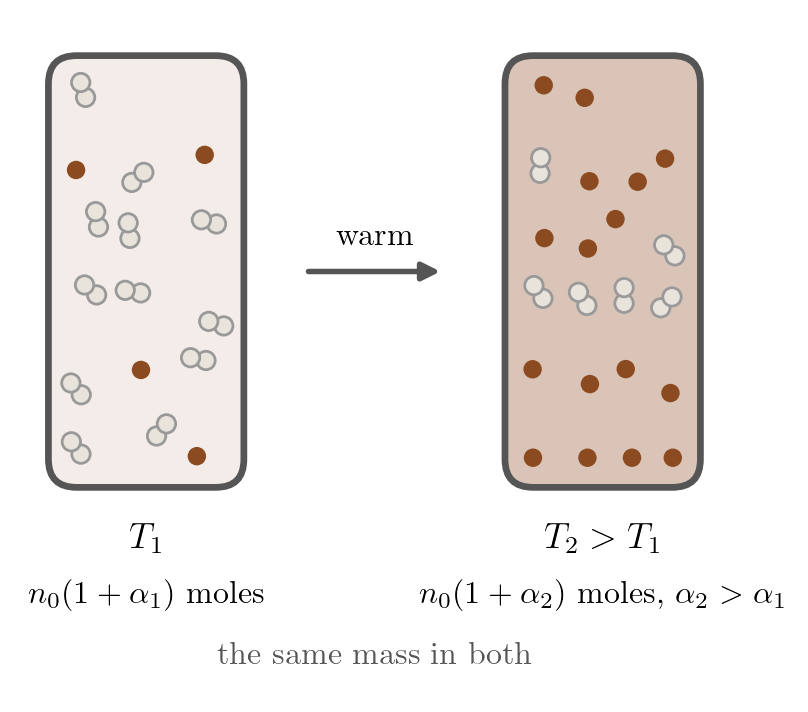
The body treated a general closed system and settled what the additive constants can depend on: the energy’s on the conserved quantities alone, the entropy’s on the reversible class, with the Third Law fixing the entropy’s. For a chemical mixture the admitted transformations are the reactions, which conserve the amount of each element, not the number of molecules: warm the sealed \(\mathrm{N_2O_4}\) tube and its mole count grows while its mass does not (Figure 12.3). So the conserved quantities \(q\) are the elemental amounts. This supplement supplies the physics behind the law for chemistry: the energy and entropy of a reaction, the observation of Nernst that stands behind the Third Law, and the absolute entropies that make the equilibrium constant of the tube computable.
12.5.1 The energy and entropy of reaction
Take a reaction that occurs. Prepare its reactants pure, each in its own vessel, in the stoichiometric proportions \(-\nu_i\) moles of each reactant \(i\) (with \(\nu_i < 0\) for a reactant), so that running the reaction to completion consumes them and leaves \(\nu_i\) moles of each product, again each pure in its own vessel at the common \(T\) and \(p\). The substances are kept apart, never mixed, so the energy and the entropy of each state are the sums over the separate vessels, \(\sum_i n_i u_i\) and \(\sum_i n_i s_i\), with no mixing terms. The reactant and product states hold the same atoms, and their differences are the energy and the entropy of reaction, \[ \begin{aligned} U_{\rm prod} - U_{\rm reac} &= \sum_i \nu_i\,u_i ,\\ S_{\rm prod} - S_{\rm reac} &= \sum_i \nu_i\,s_i , \end{aligned} \] with \(u_i\) and \(s_i\) the molar energy and entropy of the pure substance \(i\) at \((T, p)\).
The energy of reaction is measured by a run conducted in any manner: bring the reactants together, let the reaction run to completion, and record the heat \(Q\) and the work \(W\); by the First Law \(Q - W = \sum_i \nu_i u_i\), an equality between the two states however irreversibly the run proceeds in between.
The entropy of reaction is not measured so directly. An entropy difference is fixed only along a reversible process (the body), and reactants and products, though they share their atoms, are in general joined by none. The reversible process that can join them, when one exists, operates the reaction itself: a van ’t Hoff box (Figure 12.4). Each pure substance occupies its own chamber, joined to a small central chamber of equilibrium mixture through a wall permeable to it alone; each crosses its wall at its equilibrium partial pressure, so every step is reversible. The single control is the advancement \(\lambda\), and with the central chamber made negligibly small its ends, \(\lambda = 0\) and \(\lambda = 1\), are the reactant and product states themselves. The reversible work of the box, \(-\sum_i \nu_i f_i\) with \(f_i = u_i - T s_i\) the molar Helmholtz free energy (Equation 9.11), then delivers \(\sum_i \nu_i s_i\). This control carries reactant into product at fixed \(q\), the case left open in the body.
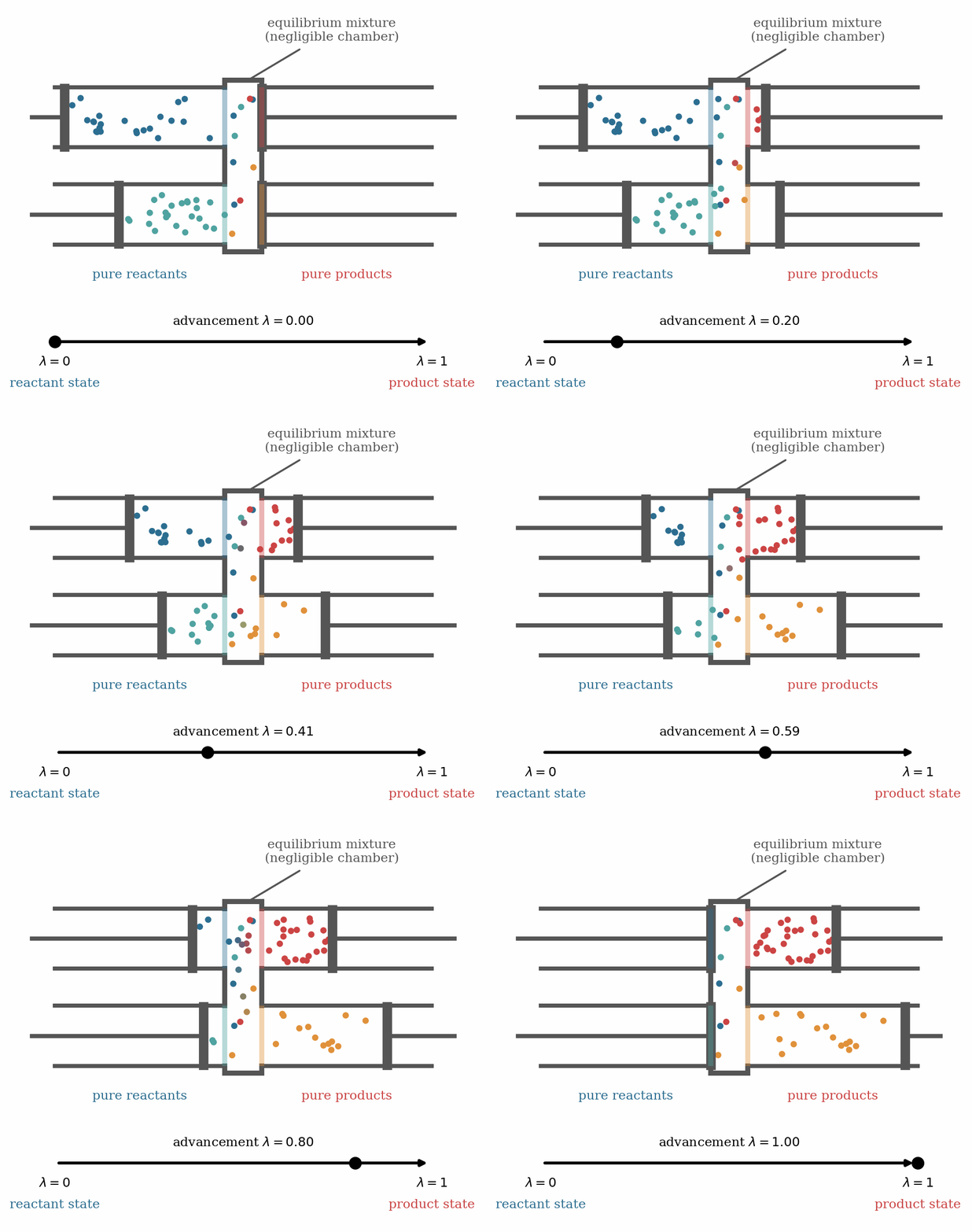
The box can be built only where the reaction has an observable equilibrium, for its central chamber must be filled with that mixture and its pistons set to the equilibrium partial pressures. Where it can, \(S_{\rm prod} - S_{\rm reac}\) is a physical observable, and the entropy constants of the two states, free in general, are tied together by it. Where the reaction instead runs to completion, with no equilibrium to reproduce, no reversible process connects the states: within a single substance the entropy constant cancels from every difference, but a reaction compares the entropies of different substances, and that comparison is the one number per reaction that no prior measurement supplies (Problem 11.5). The Third Law supplies it.
The entropy of reaction \(\sum_i \nu_i s_i\) — measurable only by a reversible operation (the van ’t Hoff box), which exists where the reaction has an observable equilibrium; the one number the Third Law supplies otherwise.
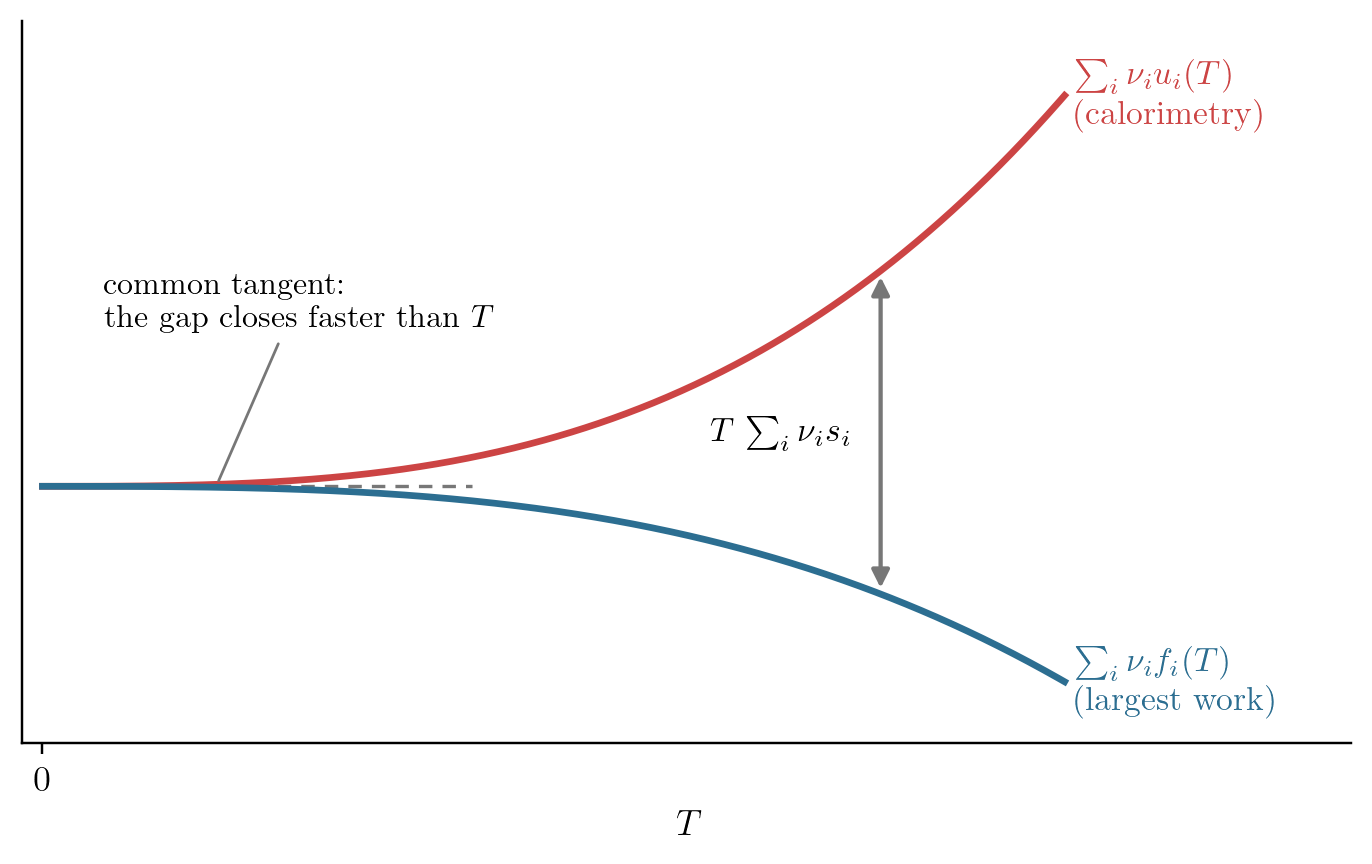
Nernst read the law off measured curves. A reaction among pure condensed phases can be run reversibly through an electrochemical cell,1 which delivers the free-energy combination \(\sum_i \nu_i f_i(T)\) down to low temperature, while calorimetry gives \(\sum_i \nu_i u_i(T)\). The gap between the two curves is \(T \sum_i \nu_i s_i\), and the slope of the work curve is \(-\sum_i \nu_i s_i\) (Equation 9.7).2 The gap closing at \(T = 0\) says nothing by itself, being \(T\) times a bounded quantity; but the curves meet with a common tangent (Figure 12.5), so the gap falls faster than \(T\) and \(\sum_i \nu_i s_i \to 0\). This is Nernst’s observation, the empirical content of the Third Law for reactions.
12.5.2 The sulfur check and Planck’s convention
Third Law — isothermal entropy changes vanish as \(T \to 0\); with Planck’s convention, \(S \to 0\) for every substance (one qualification below).
The standard check is a change of phase. At atmospheric pressure sulfur crystallises in two forms: rhombic, stable below \(T_{\rm tr} = 368.5\ \mathrm{K}\), and monoclinic, stable above. The transition absorbs \(L = 402\ \mathrm{J\,mol^{-1}}\), so at \(T_{\rm tr}\) the molar entropies differ by \(L/T_{\rm tr} = 1.09\ \mathrm{J\,K^{-1}\,mol^{-1}}\) (Equation 10.12). Monoclinic crystals persist on cooling below the transition (the transformation is slow), so both heat capacities are measurable down to low temperatures, and the same difference can be reassembled from the calorimetric integral of Lecture 6, plus whatever difference remains at \(T = 0\): \[ s^{\rm m}(T_{\rm tr}) - s^{\rm r}(T_{\rm tr}) = s^{\rm m}(0) - s^{\rm r}(0) + \int_0^{T_{\rm tr}} \frac{c_p^{\rm m}(T') - c_p^{\rm r}(T')}{T'}\,dT' . \] The measured integral matches the latent-heat value within experimental error, so \(s^{\rm m}(0) = s^{\rm r}(0)\): two crystals different in structure and in heat capacity at every finite temperature reach the same entropy at \(T = 0\).
The statement carries one qualification. “Equilibrium state” means full equilibrium internal to the substance, however strongly its transformations into other substances are inhibited. An inhibited reaction between substances is therefore no obstacle: hydrogen and oxygen that keep their composition for geological times are each in internal equilibrium, and each is covered on its own; so are metastable phases, such as the supercooled monoclinic sulfur of the check above or diamond at atmospheric pressure. Disorder frozen inside a substance is not covered: a quenched glass, or solid carbon monoxide with its molecules frozen head-or-tail at random.3 Such systems retain a residual entropy at the lowest attainable temperatures. Entropy tables flag these cases.
Residual entropy — entropy retained at the lowest temperatures by frozen-in disorder; the Third Law covers only states in full internal equilibrium.
Planck’s convention is the last clause of Principle 12.1, and it applies substance by substance. Each pure substance is a closed system, so the body’s law sets its entropy to zero at \(T = 0\); the convention makes this choice for every substance at once. It is consistent wherever a reaction connects two of them: reactant and product share their atoms, so \(\sum_i \nu_i s_i(0) = 0\) by Nernst, and the zeros chosen separately agree across the reaction, whatever reactions turn out to occur. The entropy constants thereby acquire physical values, the only convention left being the single overall zero. The energy constants have no analogous law: their zeros remain conventions attached to the conserved quantities, and if element conservation itself failed they would attach to whatever remained conserved.
12.5.3 Absolute entropies and the equilibrium constant
With \(S(0) = 0\) the entropy of a substance is absolute, \[ s(T, p_0) = \int_0^T \frac{c_p(T')}{T'}\,dT' + \sum_{\rm transitions} \frac{L_i}{T_i} , \tag{12.3}\] the integral running along \(p = p_0\) through the stable phases in turn, each transition contributing its latent heat by Equation 10.12. Two caveats follow. Below the lowest measured temperature the integral rests on the \(T^3\) form of the measured low-temperature heat capacities (a problem); and the final step corrects the real gas at \((T, p_0)\) to the ideal-gas description that Equation 11.7 uses; the corrected values are the \(s_i(T, p_0)\) below. With \(\mu^{\rm pure} = h - Ts\) for the pure gas, the equilibrium constant becomes \[ K(T) = \exp\left[ -\,\frac{\sum_i \nu_i h_i(T)}{RT} + \frac{\sum_i \nu_i s_i(T, p_0)}{R} \right] , \tag{12.4}\] computable from heat and \(p\)-\(V\)-\(T\) measurements alone: heat capacities, latent heats, one heat of reaction, and the volume data of the corrections. No measurement of the equilibrium composition enters: the Third Law supplies the entropy combination substance by substance, and the reaction never needs to be operated reversibly. This fixes the constant left open when the entropy was defined (Lecture 6) and again in the ideal-gas entropy (Lecture 7), the latter through the real-gas correction just described, and answers Problem 11.5: the equilibrium constant of the sealed tube, computed from heat data rather than read off the colour. A problem carries the computation out for \(\mathrm{N_2O_4 \rightleftharpoons 2NO_2}\), with one caveat: the tabulated entropy of \(\mathrm{NO_2}\) itself rests on statistical mechanics, pure \(\mathrm{NO_2}\) dimerising before it can be cooled to a crystal.
Absolute entropy \(s(T, p_0)\) — with \(S(0) = 0\), a calorimetric integral through the phases (Equation 12.3); the content of entropy tables.
12.6 Problems
Problem 12.1 (The energy and entropy of reaction.) A reaction runs among pure phases at a common \(T\) and \(p\), advancing by one unit.
The substances are brought together, the reaction is let run, and the pure phases are separated again at the initial \(T\) and \(p\), the heat \(Q\) and the work \(W\) recorded. Show that \(Q - W = \sum_i \nu_i u_i\) whatever the manner of the run, and hence that the energy of reaction is the same in every admissible assignment.
Operated reversibly against a single reservoir at \(T\), the reaction delivers work \(-\sum_i \nu_i f_i\), with \(f_i = u_i - T s_i\) the molar Helmholtz free energy (Equation 9.11). Using part (a), show that a reversible operation measures the entropy of reaction, \[ \sum_i \nu_i s_i = \frac{1}{T}\Big( \sum_i \nu_i u_i - \sum_i \nu_i f_i \Big) . \]
The measured curves \(\sum_i \nu_i u_i(T)\) and \(\sum_i \nu_i f_i(T)\) meet at \(T = 0\). Show that their meeting alone carries no information about \(\sum_i \nu_i s_i\), but that a common tangent there implies \(\sum_i \nu_i s_i \to 0\) (Figure 12.5).
Problem 12.2 (The van ’t Hoff box.) Reactant and product states of a reaction share their atoms.
Argue that they are two states of one closed system, so the additive constant is common to them and the energy of reaction \(U_{\rm prod} - U_{\rm reac}\) is convention-free; explain why the entropy of reaction \(S_{\rm prod} - S_{\rm reac}\) need not be, and is the number the Third Law must supply.
The box of Figure 12.4 connects the two states reversibly, passing each substance through a wall permeable to it alone at its equilibrium partial pressure. Explain why the box can be built only where the reaction has an observable equilibrium, and hence why for a reaction that runs to completion \(\sum_i \nu_i s_i\) is not measurable this way.
The central chamber is made negligibly small. Show that the box’s two ends are then the pure separated reactants and products, so that the box realizes the reactant and product states as two control-values of one closed system at fixed \(q\).
Problem 12.3 (Numerical.) At low temperatures the heat capacities of solids follow the Debye model; the table gives the model values, fitted to silver, at \(p_0 = 1\ \mathrm{bar}\).
| \(T\) / K | 15 | 25 | 50 | 75 | 100 | 150 | 200 | 250 | 298 |
|---|---|---|---|---|---|---|---|---|---|
| \(c_p\) / \(\mathrm{J\,K^{-1}\,mol^{-1}}\) | 0.58 | 2.53 | 10.78 | 16.53 | 19.62 | 22.35 | 23.43 | 23.96 | 24.25 |
Below the lowest data point assume the observed low-temperature form \(c_p = A\,T^3\). Fix \(A\) from the value at \(15\ \mathrm{K}\) and show that the interval \([0, 15\ \mathrm{K}]\) contributes \(c_p(15\ \mathrm{K})/3\) to the entropy.
Evaluate the absolute entropy \(s(298\ \mathrm{K}, p_0)\) from Equation 12.3 (no phase transition intervenes), using the trapezoidal rule for the integral of \(c_p/T\) over the table.
The tabulated entropy of silver is \(42.6\ \mathrm{J\,K^{-1}\,mol^{-1}}\); the exact integral of the model behind the table gives \(40.6\ \mathrm{J\,K^{-1}\,mol^{-1}}\). Attribute the two gaps, your result against \(40.6\) and \(40.6\) against \(42.6\): which belongs to your integration method, and which to the model?
Problem 12.4 (Completes Problem 11.5.) For the dissociation \(\mathrm{N_2O_4 \rightleftharpoons 2\,NO_2}\), entropy tables give, at \(298\ \mathrm{K}\) and \(p_0 = 1\ \mathrm{bar}\), \(s_{\mathrm{N_2O_4}}(298\ \mathrm{K}, p_0) = 304.4\ \mathrm{J\,K^{-1}\,mol^{-1}}\) and \(s_{\mathrm{NO_2}}(298\ \mathrm{K}, p_0) = 240.1\ \mathrm{J\,K^{-1}\,mol^{-1}}\); a constant-pressure calorimeter run gives the heat of reaction \(\sum_i \nu_i h_i = 57.2\ \mathrm{kJ\,mol^{-1}}\).
Compute \(\sum_i \nu_i s_i(298\ \mathrm{K}, p_0)\).
Compute \(K(298\ \mathrm{K})\) from Equation 12.4.
Compute the degree of dissociation at \(1\ \mathrm{bar}\) from the closed form of Problem 11.3 and compare with the measured room-temperature value of Lecture 11. This is the number that Problem 11.5 (c) could not compute.
A caveat: pure \(\mathrm{NO_2}\) dimerises before it can be cooled to a crystal, so its tabulated entropy does not come from a calorimeter. Explain in one or two sentences why, taking the \(\mathrm{NO_2}\) value as given, the comparison in (c) is still a genuine test of the Third Law.
Problem 12.5 Limits at absolute zero.
Suppose \(c_X(T) \to c_\infty \neq 0\) as \(T \to 0\). Show that the calorimetric integral for the entropy diverges at its lower limit, contradicting the finite limit the Third Law gives: hence Equation 12.1.
Derive \(\alpha_V \to 0\) (Equation 12.2) from Equation 9.18, and \((\partial p/\partial T)_V \to 0\) from Equation 9.17.
Show that at \(T = 0\) every isothermal displacement is also isentropic: the \(T = 0\) isotherm coincides with the \(S = 0\) adiabat.
Problem 12.6 (More demanding.) The staircase of Figure 12.2, quantitatively.
A solid obeying the Debye model has \(S(T, p) = a(p)\,T^3\) at low temperature, with \(a_2 = a(p_2) < a_1 = a(p_1)\) for \(p_2 > p_1\). Cooling alternates isothermal compressions \(p_1 \to p_2\) with adiabatic expansions \(p_2 \to p_1\). Show that \(T_{k+1} = (a_2/a_1)^{1/3}\,T_k\): the temperatures form a geometric sequence. How many steps lead from \(T_0\) to a prescribed \(T > 0\), and why is \(T = 0\) not reached in finitely many?
The ideal gas violates Principle 12.1: show from Equation 8.5 that the isothermal entropy change between two volumes, hence (via \(pV = nRT\)) between two pressures, is the same at every temperature.
Yet absolute zero remains unattainable for the ideal gas: within a plateau of \(c_p\), show that the adiabatic step multiplies the temperature by \((p_1/p_2)^{R/c_p} < 1\), again a geometric sequence. Evaluate the factor for a diatomic gas and \(p_2/p_1 = 10\). Conclude: unattainability does not imply the Third Law.
In a cell the advance of the reaction drives a charge through the terminals; a counter-voltage balancing the cell’s electromotive force holds it quasi-static at any composition, needing no knowledge of an equilibrium mixture.↩︎
The cell works at atmospheric pressure, so a volume term \(p \sum_i \nu_i v_i\) enters the work; for condensed phases it is negligible against the reaction energies, and its temperature derivative against the reaction entropies.↩︎
The difference from an inhibited reaction is this: inhibition holds the system in one reproducible equilibrium state at each \(T\) and \(p\), whereas a quench fixes a random microscopic arrangement, and no short list of constrained variables can turn that arrangement into an equilibrium state.↩︎