1 Motivations
Last updated: 01-06-2026
This lecture is motivational in character. The arguments are deliberately informal: they are meant to build intuition and explain why a macroscopic description of matter is possible, not to establish precise definitions. Starting from Lecture 2, the style changes: concepts are defined carefully and results are derived with precision.
1.1 Two ways of describing matter
Matter is made of atoms and molecules. A glass of water contains roughly \(8 \times 10^{24}\) water molecules; a litre of air at room temperature contains about \(3 \times 10^{22}\) molecules of nitrogen and oxygen. Each of these molecules moves, rotates, and collides with its neighbours incessantly. In principle, the state of such a system is specified by the position and velocity of every single constituent, an absurd amount of information that neither we nor any conceivable computer could store or use.
And yet, in practice, we describe a glass of water with just a handful of numbers: its temperature, pressure, volume, and chemical composition. These few numbers are enough to predict how the water will behave: whether it will boil, how much heat it absorbs when warmed, what happens when we mix it with another substance. This is the central miracle of thermodynamics, and we begin by asking why it works. The answer lies in a vast separation of scales between the microscopic world of molecules and the macroscopic world of our measurements.
1.2 Characteristic microscopic scales
To appreciate this scale separation, we need concrete numbers. The relevant microscopic scales are those of length, time, and energy. We introduce them here for helium (He) gas, a dilute monatomic gas whose atoms have no internal degrees of freedom at room temperature and can therefore be treated as structureless point particles. Every substance has its own characteristic microscopic scales, but the structure of the argument is the same.
1.2.1 Length scales
A helium atom has an effective collision diameter of roughly
\[d \sim 3 \times 10^{-10}\ \text{m} = 3\ \text{Å.}\]
At atmospheric pressure and room temperature, He atoms are separated by a mean distance of about \(3\text{–}4\ \text{nm}\), roughly ten atomic diameters. An atom travels on average a distance
\[\ell \sim 200\ \text{nm}\]
before colliding with another atom. This mean free path \(\ell\) is much larger than the atomic diameter (\(\ell/d \approx 700\)), which means He atoms spend almost all their time in free flight.
1.2.2 Time scales
Helium atoms are light and therefore fast. The speed of a typical He atom at room temperature (\(300\ \text{K}\)) is of order
\[v \sim 1400\ \text{m/s,}\]
about four times the speed of sound. From the mean free path and this speed, the mean free time between collisions is
\[\tau \sim \frac{\ell}{v} \sim \frac{200 \times 10^{-9}}{1400} \sim 10^{-10}\ \text{s.}\]
In one second, a single atom undergoes roughly \(10^{10}\) collisions, about ten billion. The microscopic world operates on a timescale ten orders of magnitude faster than a second.
1.2.3 Energy scales
Between collisions, a He atom travels freely. Because the atoms are far apart most of the time and carry no relevant internal structure, the energy of a single atom is purely kinetic:
\[\varepsilon = \frac{1}{2}mv^2.\]
Using the atomic mass \(m \approx 6.6 \times 10^{-27}\ \text{kg}\) and the typical speed above:
\[\varepsilon \approx \frac{1}{2} \times 6.6 \times 10^{-27} \times (1400)^2 \approx 6 \times 10^{-21}\ \text{J.}\]
The assumption that the energy is purely kinetic deserves justification. The lowest electronic excitation of He lies at about \(20\ \text{eV} \approx 3 \times 10^{-18}\ \text{J}\), nearly three orders of magnitude above \(\varepsilon\). Thermal collisions are far too gentle to excite He atoms internally; their internal structure is completely frozen. This is the sense in which He atoms behave as structureless point particles at room temperature. “Point-like” does not mean size-zero: the atoms still have a finite collision diameter \(d \sim 3\ \text{Å}\), as introduced above. It means rather that no internal degree of freedom is accessible: the atom has no handle by which a thermal collision can deposit energy into its interior. The only energy is translational kinetic energy.
These three scales — \(d\), \(\tau\), and \(\varepsilon\) — define the microscopic world of the He gas. Table 1.1 collects them.
| Quantity | Symbol | Value |
|---|---|---|
| Atomic diameter | \(d\) | \(3 \times 10^{-10}\ \text{m}\) \(= 3\ \text{Å}\) |
| Mean free path | \(\ell\) | \(2 \times 10^{-7}\ \text{m}\) \(= 200\ \text{nm}\) \(\approx 700\,d\) |
| Mean atomic speed | \(v\) | \(\sim 1400\ \text{m/s}\) \((\approx 4\times \text{speed of sound})\) |
| Mean free time | \(\tau = \ell/v\) | \(\sim 10^{-10}\ \text{s}\) \((10^{10}\ \text{collisions/s})\) |
| Kinetic energy per atom | \(\varepsilon = \frac{1}{2}mv^2\) | \(\approx 6 \times 10^{-21}\ \text{J}\) |
A word of caution. These numbers are specific to helium at low density. Polyatomic gases such as N₂ have internal degrees of freedom (rotation and vibration) absent from He; the energy of a molecule is no longer purely translational kinetic energy, and the point-particle description no longer applies. For liquids and solids the mean free path shrinks to atomic separations, and the gas-kinetic language breaks down entirely. What is universal is the existence of well-separated microscopic and macroscopic scales, and the fact that macroscopic measurements inevitably average over many microscopic events. Thermodynamics is built on this universal feature, not on the specifics of any one substance.
1.3 The macroscopic world: large numbers and averages
The characteristic feature of a macroscopic object is that it contains an enormous number of microscopic constituents. Consider again a glass of water (\(250\ \text{mL}\)). Using Avogadro’s number \(N_A \approx 6 \times 10^{23}\ \text{mol}^{-1}\) and the molar mass of water (\(18\ \text{g/mol}\)):
\[N = \frac{250\ \text{g}}{18\ \text{g/mol}} \times 6 \times 10^{23}\ \text{mol}^{-1} \approx 8 \times 10^{24}\ \text{molecules.}\]
For perspective: this exceeds the estimated number of stars in the observable universe (\(\sim 10^{23}\)) by nearly two orders of magnitude.
Any macroscopic measurement — reading a pressure gauge, taking a temperature with a thermometer — involves a probe that is itself large and slow by microscopic standards. A pressure sensor with a face of area \(A = 1\ \text{mm}^2\) responding in \(\Delta t = 1\ \text{ms}\) is, on the atomic scale, an enormous detector operating over “geological” timescales relative to \(\tau \sim 10^{-10}\ \text{s}\): a millisecond encompasses about \(10^7\) mean free times. The measurement cannot track individual atomic events; it can only record their collective outcome.
This brings us to the central conceptual step: macroscopic observables are averages of microscopic quantities, taken over so many events that fluctuations are negligible.
1.3.1 Pressure: a worked example of averaging
Pressure is the ideal first illustration, because what is being averaged has a familiar name: force.
At the microscopic level, He atoms bombard the face of a pressure sensor in a random, intermittent fashion. Each atom that strikes the surface and rebounds delivers an impulsive force: a brief, sharp kick. These impulses are irregular in time, random in magnitude, and individually far too fast and too weak to measure directly. The instantaneous force \(F(t)\) on the sensor face is a wildly fluctuating signal, as sketched in Figure 1.1.
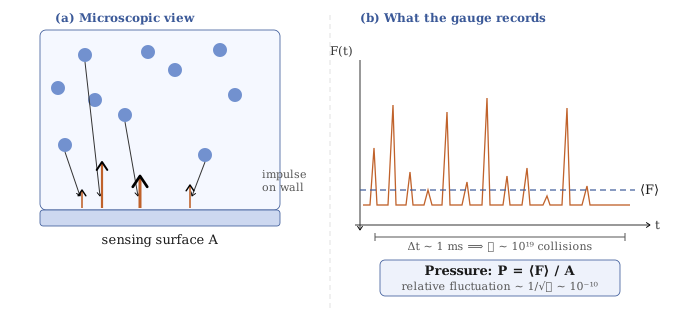
How many collisions contribute to a single pressure reading? For a sensor of area \(A = 1\ \text{mm}^2\) responding over \(\Delta t = 1\ \text{ms}\), the number of atomic impacts is approximately
\[\mathcal{N} \sim n\, v\, A\, \Delta t\]
where \(n \sim 10^{25}\ \text{m}^{-3}\) is the number density. Substituting,
\[\mathcal{N} \sim 10^{25} \times 1400 \times 10^{-6} \times 10^{-3} \sim 10^{19}.\]
The gauge averages over roughly \(10^{19}\) impulsive events. Each He atom of mass \(m \approx 6.6 \times 10^{-27}\ \text{kg}\) that reflects from the wall transfers a momentum \(\sim 2mv \sim 2 \times 10^{-23}\ \text{N\,s}\) (using the full speed \(v\) as an order-of-magnitude estimate for the normal component). The time-averaged force is therefore
\[\langle F \rangle \sim \frac{\mathcal{N} \cdot 2mv}{\Delta t} \sim \frac{10^{19} \times 2 \times 10^{-23}}{10^{-3}} \sim 0.2\ \text{N},\]
giving a pressure \(\langle F \rangle / A \sim 2 \times 10^5\ \text{Pa}\), the right order of magnitude for atmospheric pressure. By the central limit theorem, the relative fluctuation of the average around its mean is of order
\[\frac{\delta F}{\langle F \rangle} \sim \frac{1}{\sqrt{\mathcal{N}}} \sim 10^{-10}.\]
Let \(X_1, X_2, \ldots, X_N\) be independent random variables, each with mean \(\mu\) and variance \(\sigma^2\). Because variances add for independent variables, their sum \(S = X_1 + \cdots + X_N\) has mean \(N\mu\) and standard deviation \(\sqrt{N}\,\sigma\). The relative fluctuation of the sum is therefore \[ \frac{\sqrt{N}\,\sigma}{N\mu} = \frac{\sigma/\mu}{\sqrt{N}}, \] which vanishes as \(N \to \infty\). The central limit theorem strengthens this: it states that, for large \(N\), the distribution of \(S\) is approximately Gaussian regardless of the distribution of the individual \(X_i\). The \(1/\sqrt{N}\) suppression of relative fluctuations is the consequence that matters for thermodynamics.
For further reading: Wikipedia — Central limit theorem.
This is ten orders of magnitude below any measurable signal. The result is a perfectly stable, reproducible number: the pressure
\[p = \frac{\langle F \rangle}{A}.\]
1.3.2 Internal energy: a second example
The internal energy \(U\) is a second illustration of the same principle: it is, in fact, the total energy (as defined in your Mechanics or Electromagnetism courses) of the system averaged over a macroscopic time scale.
For the He gas considered above, interactions between atoms are negligible between collisions, so the total energy is the sum of kinetic energies:
\[U = \sum_{i=1}^{N} \frac{1}{2} m v_i^2.\]
Each atom’s kinetic energy fluctuates with every collision, but the sum is self-averaging. Using the kinetic energy per atom \(\varepsilon \approx 6 \times 10^{-21}\ \text{J}\) estimated in Section 1.2, one mole of He (\(N_A \approx 6 \times 10^{23}\) atoms) has internal energy
\[U \approx N_A\, \varepsilon \sim 6 \times 10^{23} \times 6 \times 10^{-21}\ \text{J} \sim 4\ \text{kJ.}\]
The relative fluctuation of this sum is \(1/\sqrt{N_A} \sim 10^{-12}\), entirely negligible. Any realistic measurement of internal energy or, rather, internal energy variations also operates over a response time \(\Delta t \gg \tau\), during which each atom undergoes many collisions and its kinetic energy fluctuates repeatedly. This time averaging acts on top of the sum over particles, suppressing fluctuations further still. Like pressure, internal energy is a stable, reproducible macroscopic observable.
1.3.3 What these examples teach — and what they do not
These examples make the averaging argument concrete, but their scope is limited: both were computed for He gas, where atoms are structureless and interact only during brief collisions. For gases of polyatomic molecules (N₂, CO₂, …) the molecules still spend most of their time in free flight between collisions, but each molecule has internal structure (its constituent atoms are bound together and can rotate and vibrate), so the internal energy includes rotational and vibrational contributions in addition to translational kinetic energy. For liquids and solids the mean free path shrinks to molecular separations, and the gas-kinetic language breaks down entirely.
What survives in all cases is the core conclusion: any macroscopic measurement averages over an enormous number of microscopic contributions, both in particle number and in time, and the central limit theorem makes the result stable and reproducible. The thermodynamic definitions of pressure and internal energy rest on this conclusion alone, not on any detail specific to He or to a dilute gas.
1.4 Universal laws and emergent observables
The scale separation discussed above has a profound consequence. Because macroscopic observables are averages over an enormous number of molecular events, their values are insensitive to molecular details: the specific interactions, the precise trajectories, the internal structure of individual molecules. The laws that govern these averages are therefore universal: they hold for any macroscopic system in equilibrium, regardless of its molecular constitution. A litre of helium and a litre of nitrogen behave entirely differently at the molecular level, yet both obey the same thermodynamic laws. This universality is the defining feature of thermodynamics, and it follows directly from the separation of scales.
The macroscopic description introduces physical quantities of a new kind. Pressure and internal energy have a direct microscopic interpretation: they are averages and sums of molecular quantities, as shown in the preceding sections. Two further quantities, temperature \(T\) and entropy \(S\), are of a different character. There is nothing at the molecular level that can be summed or averaged to yield them. These are emergent quantities: they acquire meaning only for a macroscopic system in equilibrium, and their precise definitions emerge from the laws of thermodynamics, not from any microscopic model.
A practical implication: kinetic theory and statistical mechanics can derive thermodynamic relations for specific models, but a result that relies on molecular details holds for that model only. The laws of thermodynamics stand independently of any microscopic interpretation, and the arguments in this course will respect that independence.
1.5 Goals of thermodynamics
Thermodynamics addresses three interconnected questions, corresponding to three empirical laws.
Equilibrium states. What variables are needed to characterise a system in equilibrium, and how are they constrained by equations of state? This is the domain of the Zeroth Law, which establishes temperature as a well-defined observable.
Transformations between states. When a system passes from one equilibrium state to another (by heating, compressing, or letting matter flow in), how much work is done and how much heat is exchanged? This is the domain of the First Law, which introduces internal energy and expresses conservation of energy.
The direction of change. Not all transformations consistent with energy conservation occur: heat flows spontaneously from hot to cold, never the reverse; gases expand but do not spontaneously contract. These facts require entropy and the Second Law.
1.6 Scale separation: a recurring theme in physics
This section is supplementary and will not be covered in lecture.
The idea that a large ratio of scales permits a simplified description, one that discards short-distance detail without losing predictive power, is a recurring theme across physics.
Point-particle approximation. When the distance between two bodies greatly exceeds their sizes, each can be treated as a structureless mass concentrated at a point. The Earth (radius \(6.4 \times 10^6\ \text{m}\)) and the Sun (radius \(7 \times 10^8\ \text{m}\)) are separated by \(1.5 \times 10^{11}\ \text{m}\); even the Sun’s radius is only \(5 \times 10^{-3}\) times the orbital distance, so both bodies interact as point masses to excellent precision, despite their considerable internal structure.
Multipole expansion. The potential of an arbitrary charge distribution at a distance \(r \gg a\) (where \(a\) is the size of the source) can be written as a series in \(a/r\), with terms corresponding to the total charge, the dipole moment, the quadrupole moment, and so on. The internal arrangement of charges enters only through these integrated moments; everything else is invisible at large distances.
Hydrogen atom. To compute the energy levels, one treats the proton as a structureless point charge. The proton’s internal structure, governed by quantum chromodynamics at scales \(\sim 10^{-15}\ \text{m}\), is five orders of magnitude smaller than the Bohr radius \(a_0 \approx 5 \times 10^{-11}\ \text{m}\), and its effect on atomic spectra is a tiny correction.
Effective field theories. Fermi’s theory of beta decay describes nuclear processes accurately at \(\text{MeV}\) energies without any reference to \(W\)-boson exchange at \(80\ \text{GeV}\): the ratio of scales \(E/M_W \sim 10^{-5}\) is so small that the heavy mediator is invisible, and its effect reduces to a single effective coupling constant.
Quasi-particles. In condensed matter physics, the elementary excitations of a many-body system (phonons, magnons, Cooper pairs) behave as independent particles with well-defined quantum numbers and sharp dispersion relations, even though each is a collective motion of a macroscopic number of interacting constituents. The microscopic complexity is absorbed into a handful of effective parameters.
In each case, as in thermodynamics, a large ratio of scales permits an effective description that is simultaneously simpler and more general than the underlying microscopic theory.
1.7 Summary
The microscopic world
- For helium gas at room temperature, the characteristic microscopic scales are: collision diameter \(d \sim 3\ \text{Å}\), mean free path \(\ell \sim 200\ \text{nm}\), mean speed \(v \sim 1400\ \text{m/s}\), mean free time \(\tau \sim 10^{-10}\ \text{s}\), and kinetic energy per atom \(\varepsilon = \frac{1}{2}mv^2 \sim 6 \times 10^{-21}\ \text{J}\).
- He atoms behave as structureless point particles because their lowest electronic excitation (\(\sim 20\ \text{eV}\)) is nearly three orders of magnitude above \(\varepsilon\): no internal degree of freedom is accessible. This does not mean the atoms have zero size.
The macroscopic world
- Macroscopic measurements average over enormous numbers of microscopic events, in both particle number and time. By the central limit theorem, fluctuations are negligible: relative fluctuations scale as \(1/\sqrt{\mathcal{N}}\).
- Pressure is the time average of atomic impact force per unit area. A pressure sensor averaging over \(\sim 10^{19}\) impacts has relative fluctuations \(\sim 10^{-10}\).
- Internal energy is the sum of atomic kinetic energies. For one mole of He, \(U \approx N_A \varepsilon \sim 4\ \text{kJ}\), with relative fluctuations \(\sim 10^{-12}\).
- Temperature and entropy are emergent quantities: unlike pressure and internal energy, they are not averages or sums of any molecular quantity. They acquire meaning only for a macroscopic system in equilibrium.
Thermodynamics
- The laws governing macroscopic observables are universal: insensitive to molecular details, they hold for any macroscopic system in equilibrium regardless of its constitution (for instance, the equation of state for a dilute gas is the same for hydrogen and nitrogen).
- The goals of thermodynamics are to characterise equilibrium states (Zeroth Law), to constrain transformations between states via energy conservation (First Law), and to identify the direction of spontaneous change (Second Law).
- Thermodynamics derives its results from empirical laws alone, without assuming any microscopic model.
1.8 Problems
Problem 1.1 A block of mass \(m\) rests on a smooth horizontal surface. A constant horizontal force \(F\) acts on the block over a displacement \(d\). (a) Compute the work done by the force. (b) Using the work-energy theorem, find the speed of the block at the end of the displacement, assuming it starts from rest.
Problem 1.2 A particle of mass \(m\) is attached to a spring of constant \(k\). It is displaced a distance \(A\) from equilibrium and released. As the particle moves from \(x = A\) back to \(x = 0\), the spring exerts the restoring force \(F(x) = -kx\). (a) Compute the work done by the spring over this displacement. (b) Verify that this equals the kinetic energy of the particle at \(x = 0\).
Problem 1.3 A force field in the \((x,y)\) plane is \(\mathbf{F}(x,y) = (y,\, 0)\) (SI units). A particle moves from \(O = (0,0)\) to \(P = (1,1)\) along two paths: (a) the straight line \(y = x\); (b) the two-segment path \(O \to (1,0) \to P\). Compute the work \(W = \int_{\mathcal{C}} \mathbf{F}\cdot d\mathbf{r}\) along each path. Is the work independent of the path? Is the force field conservative?
Problem 1.4 A macroscopic pressure sensor with face area \(A = 1\ \text{mm}^2\) and response time \(\Delta t = 1\ \text{ms}\) averages over \(\mathcal{N} \sim 10^{19}\) atomic impacts, giving a relative pressure fluctuation \(\sim 10^{-10}\). Consider instead a nanomechanical sensor with \(A = (100\ \text{nm})^2\) and \(\Delta t = 1\ \text{ns}\). Give an order-of-magnitude estimate of \(\mathcal{N}\) and of the relative pressure fluctuation for this sensor. Is pressure a well-defined quantity at this scale?
Problem 1.5 Using the relation \(\varepsilon = \frac{1}{2}mv^2\) and assuming the same kinetic energy \(\varepsilon \approx 6 \times 10^{-21}\ \text{J}\) for all gases at room temperature, give order-of-magnitude estimates of the mean atomic speed for H\(_2\) (\(m \approx 3.3 \times 10^{-27}\ \text{kg}\)) and Ar (\(m \approx 6.6 \times 10^{-26}\ \text{kg}\)). Compare with the He result from the lecture and with the speed of sound in air (\(\approx 340\ \text{m/s}\)).
Problem 1.6 The first vibrational excitation of N\(_2\) lies at about \(0.3\ \text{eV}\). Using \(\varepsilon \approx 6 \times 10^{-21}\ \text{J}\) for the kinetic energy per particle at room temperature (\(T = 300\ \text{K}\)), compare \(\varepsilon\) with \(0.3\ \text{eV}\) and decide whether the point-particle approximation is valid for N\(_2\) at room temperature.
At higher temperatures, kinetic energy increases proportionally to temperature: \(\varepsilon(T) \approx \varepsilon(300\ \text{K}) \times T / (300\ \text{K})\). Estimate the temperature at which \(\varepsilon\) reaches the vibrational excitation threshold.
Problem 1.7 Give an order-of-magnitude estimate of the internal energy of \(1\ \text{L}\) of He at room temperature and atmospheric pressure. Use the number density \(n \approx 2.5 \times 10^{25}\ \text{m}^{-3}\) and \(\varepsilon \approx 6 \times 10^{-21}\ \text{J}\). By how much does this energy fluctuate in an absolute sense?
Problem 1.8 Sound waves in a gas are a macroscopic phenomenon. The wavelength of a \(1\ \text{kHz}\) sound wave in He is roughly \(1\ \text{m}\), and the mean free time is \(\tau \sim 10^{-10}\ \text{s}\). Give an order-of-magnitude estimate of the number of mean free times in one period of the wave. Repeat for a \(1\ \text{GHz}\) ultrasound wave. Discuss what these ratios imply for the validity of a thermodynamic description of the gas.
Problem 1.9 In a hard-sphere gas, molecules are modelled as rigid spheres of diameter \(d\) that interact only through elastic collisions. The mean free path of such a gas is \(\ell = 1/(\sqrt{2}\,\pi d^2 n)\), where \(n\) is the number density. Using \(d = 3\ \text{Å}\) and \(n \approx 2.5 \times 10^{25}\ \text{m}^{-3}\), verify that \(\ell \approx 200\ \text{nm}\) for He. Compute \(\ell\) for N\(_2\) using \(d_{\rm N_2} \approx 3.7\ \text{Å}\) and the same number density, and compare the ratio \(\ell/d\) for both gases.